

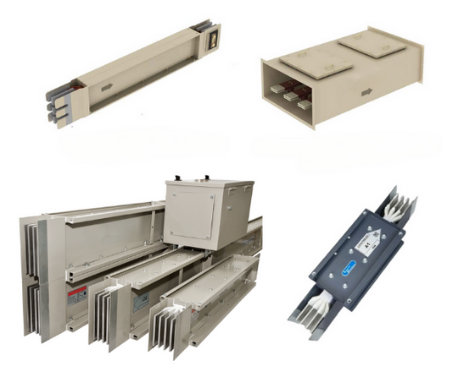
Busduct systems designed to meet different voltage ratings, current capacities, and environmental conditions.
These include:
• Low Voltage (LV) Busducts:
Typically used for power distribution within buildings and industrial facilities where voltage levels are below 1000V.
• Medium Voltage (MV) Busducts:
Used for higher voltage levels up to 36kV, suitable for larger industrial applications and power distribution networks.
• High Voltage (HV) Busducts:
Designed for very high voltage applications, typically above 36kV, used in substations and large-scale power transmission systems.
• Compact Design:
Busducts are compact compared to traditional cable systems, saving space and allowing for more flexible installation.
• Efficient Power Transmission:
They offer low impedance, reducing power losses and improving overall energy efficiency.
• Easy Installation and Maintenance:
Modular construction and pre-engineered components facilitate quick installation and easier maintenance compared to cable systems.
• Scalability:
Busduct systems can be easily expanded or modified to accommodate future changes in electrical load requirements.
• Safety:
Busducts are designed with safety features such as insulation materials and protective enclosures to prevent electrical faults and ensure operator safety.
Busducts find applications across various industries, including:
• Manufacturing:
Used in factories for distributing power to machines and equipment.
• Commercial Buildings:
Provide power distribution solutions in office buildings, shopping malls, and hotels.
• Data Centers:
Ensures reliable power distribution to critical IT infrastructure.
• Utilities:
Used in substations and power plants for efficient power transmission.
• Renewable Energy:
Integrates with solar and wind farms for efficient energy distribution.